Full Wheel vs Part Wheel in Horse Racing: Cost, Strategy and When Each Wins
 Available in US
Every wheel bet starts with the same decision: do you cover everything, or do you cut? A full wheel includes every runner in the field for the open positions. A part wheel narrows those positions to a selected group. The cost difference between the two can be enormous – sometimes a factor of five or more – and the strategic implications run deeper than most bettors realise.
I have built thousands of wheel tickets over nine years, and if there is one lesson that stands above the rest, it is this: the choice between full and part wheel is not about appetite for risk. It is about the quality of your opinion. A full wheel says “I have no idea who fills the other positions.” A part wheel says “I can narrow it down.” Both are valid statements, but they apply to different races, and confusing the two is one of the most expensive habits in exotic betting.
This guide lays out the structural differences between full wheels, part wheels and box bets, compares their costs side by side, walks through five race scenarios that match each structure to specific conditions, and covers the back wheel – a less common but tactically valuable variant that keys a horse for a lower finishing position. For the detailed cost formulas behind each bet type, the horse racing wheel bet calculator provides the full mathematical framework.
Table of Contents
- Full Wheel: Maximum Coverage at Maximum Cost
- Part Wheel: Targeted Combinations for Controlled Spend
- Side-by-Side Cost Comparison: Full Wheel, Part Wheel and Box
- Five Scenarios: Matching Wheel Structure to Race Conditions
- The Back Wheel: Keying a Horse to Finish Behind Your Picks
- Step-by-Step: Building Your Wheel From the Race Card
- Frequently Asked Questions
Full Wheel: Maximum Coverage at Maximum Cost
The full wheel is a blunt instrument, and I mean that as a compliment. It does one thing perfectly: it guarantees coverage of every possible combination in the open positions, provided your key horse finishes where you placed it. There is no selection risk in the non-key legs, no chance of being caught out by a surprise runner sneaking into the frame. If your key delivers, you win. Period.
Structurally, a full trifecta wheel with one key horse in a race of n runners generates (n – 1) x (n – 2) combinations. In a field of 9 runners – close to the 2025 UK Flat average of 8.90 – that is 8 x 7 = 56 combinations. At a 1 pound unit stake, the ticket costs 56 pounds. Every possible second-and-third-place finishing order, excluding the key horse, is covered.
The full wheel’s strength is also its weakness: it is expensive in proportion to the field size, and it makes no distinction between likely and unlikely runners in the open positions. A 33/1 no-hoper who has not finished in the first three all season carries the same weight in your ticket as the 3/1 second favourite. You are paying for combinations that your form analysis might tell you are virtually impossible.
When does that indiscriminate coverage make sense? In races where the open positions are genuinely unpredictable – large-field handicaps where any number of runners have a chance of placing, competitive conditions races with unexposed improvers, or National Hunt chases on heavy ground where the attrition rate makes the finishing order a lottery. If you cannot honestly eliminate more than one or two runners from contention, the full wheel earns its higher cost through comprehensive coverage.
The full wheel also makes sense when the key horse represents overwhelming value. If you have identified a horse at 8/1 or bigger that you believe has a genuine winning chance, and the potential trifecta dividend justifies the ticket cost, a full wheel maximises your probability of collecting. The alternative – part-wheeling and missing the tricast because you excluded the runner who finished third – is a painful outcome when your key horse actually won.
Part Wheel: Targeted Combinations for Controlled Spend
I once sat next to a professional punter at Newmarket who told me he had not played a full wheel in three years. “Every race has at least two horses I can cross out before I even look at the form,” he said. “Why would I pay for combinations that include them?” That philosophy is the foundation of part-wheel betting.
A part wheel replaces the full field in the open positions with a curated group of runners. Instead of wheeling all 9 remaining horses through second and third in a trifecta, you select 5 or 6 that you consider realistic contenders. The formula adjusts: with s selected runners, the combination count becomes s x (s – 1), rather than (n – 1) x (n – 2). The cost reduction is substantial. In a 10-runner race, a full one-key trifecta wheel costs 72 combinations. A part wheel with 6 selected runners costs 30 – a 58% saving.
The part wheel demands something the full wheel does not: an opinion about who should not be in the frame. That sounds easy in theory, but it requires genuine form analysis. You need to identify runners whose chance of finishing in the relevant positions is low enough to justify excluding them. Ground preferences, class, fitness, draw bias, jockey bookings, recent run style – all of these feed into the exclusion decision.
The danger of part-wheeling is obvious: if one of your excluded runners finishes in the frame alongside your winning key horse, you have a dead ticket and the knowledge that a full wheel would have landed. This is the trade-off, and there is no escaping it. Part-wheeling saves money at the cost of coverage, and the skill lies in making that trade-off correctly more often than not.
Where part wheels really shine is across a multi-race session. If you are betting trifecta wheels on four races in an afternoon, the cumulative cost of four full wheels can easily exceed 250 pounds. Four part wheels, each saving 40% to 60% on combinations, might total 120 pounds. That 130 pound saving is not just about the money – it is about sustainability. A bettor who can afford to wheel four races in an afternoon has four chances to land a dividend. A bettor who blew the entire budget on two full wheels has two chances and then sits idle.
Side-by-Side Cost Comparison: Full Wheel, Part Wheel and Box
Seeing the numbers side by side settles most arguments about wheel structure faster than any amount of theory. Consider a trifecta at three representative field sizes, all at a 1 pound unit stake with the part wheel assuming 6 selected runners for the open positions. In a 9-runner race, a full wheel with one key horse costs 56 combinations, a part wheel costs 30 and a full box covering all runners in every order costs 504. At 12 runners, the full wheel rises to 110, the part wheel stays at 30 and the box balloons to 1,320. At 16 runners, the full wheel hits 210, the part wheel is still 30 and the box reaches 3,360.
The part wheel’s advantage is immediately obvious: its cost is fixed by the number of selected runners, not by the total field size. Whether the race has 9 runners or 16, selecting 6 for the open positions always produces 30 combinations. The full wheel, by contrast, grows with the field. And the box – which covers every permutation of every runner – grows explosively.
The box bet deserves a closer look because it represents the opposite philosophy to the wheel. A box says “I have no idea which horse wins, finishes second or finishes third – I just think these runners will fill the first three places in some order.” In a 9-runner full box trifecta, that is 9 x 8 x 7 = 504 combinations. In a 12-runner box, 1,320. In a 16-runner box, 3,360. These are not realistic ticket prices for almost any bettor, which is why boxes are typically limited to small groups of 3 to 5 runners.
A 5-runner trifecta box costs 60 combinations – comparable to a full wheel in a 9-runner race but offering fundamentally different coverage. The box covers all finishing orders of those 5 specific horses. The full wheel covers all possible second-and-third combinations behind a single key horse. The box hedges against order uncertainty; the wheel hedges against identity uncertainty. Choosing between them depends on whether your doubt is about which horse finishes where (box) or which horses finish in the frame at all (wheel).
Premier Flat fixtures averaging 11.02 runners push full wheel costs to 90 combinations – still manageable but approaching the boundary where part-wheeling starts to look more sensible. At National Hunt’s average of 7.84 runners, full wheels stay affordable at around 42 combinations, making the jumps calendar more hospitable to full-wheel strategies.
Five Scenarios: Matching Wheel Structure to Race Conditions
Theory is fine, but exotic betting is a practical discipline. Here are five race scenarios I encounter regularly, each matched to the wheel structure that fits it best.
Scenario one: the class dropper. A Group 3 winner drops into a listed race with 8 runners on a course it has won at twice. You rate this horse as a near-certainty to win, but the minor placings are open. This is a textbook full wheel situation. The key horse opinion is strong, the field is small enough that the cost is reasonable (42 combinations for a trifecta), and you genuinely cannot separate the remaining runners for second and third. Full wheel, key to win, let the rest sort themselves out.
Scenario two: the wide-open handicap. A 16-runner heritage handicap at York. You like one horse to win but rate three of the runners as no-hopers – wrong ground, out of form, or clearly outclassed. Part wheel: key your selection to win, exclude the three you have eliminated, and wheel the remaining 12 through second and third. That gives you 12 x 11 = 132 combinations instead of 210 for a full wheel – a 37% saving for what should be a negligible reduction in coverage.
Scenario three: the match race. A 6-runner Group 1 where two horses dominate the market at short prices and the rest are outsiders. You are confident both principals will fill the first two places, but you are not sure which one wins. This is a box scenario. Box the two market leaders with one or two outsiders you rate for third. A 3-runner trifecta box costs just 6 combinations. A 4-runner box costs 24. Both are tiny tickets relative to any wheel structure, and the box’s order-agnostic coverage matches your uncertainty perfectly.
Scenario four: the pace-dependent jumps race. A 10-runner staying chase where one horse has a pronounced front-running style. If it gets an easy lead, it wins. If pressured early, it fades. You want exposure to the win but also want protection against the fade scenario. This calls for a split approach: a top wheel with the front-runner keyed to win (9 combinations for an exacta), plus a separate part-wheel trifecta keying a different horse for second or third. The two tickets combined give you coverage across different race shapes.
Scenario five: the festival handicap. Cheltenham, 20 runners, no standout key horse. BHA modelling projects a 6 to 7% reduction in total races by 2027, which Richard Wayman linked to the need to develop strategies supporting horse number growth. But right now, big festival handicaps still produce huge fields. In these races, the honest assessment is often that you do not have a strong enough key-horse opinion to justify any wheel. A small box of 4 or 5 fancied runners, or even a simple each-way bet, might be more appropriate than forcing a wheel structure onto a race that does not suit it. Not every race needs an exotic. Recognising that is part of the discipline.
The Back Wheel: Keying a Horse to Finish Behind Your Picks
Most wheel bets key a horse to win – what I call a top wheel. The back wheel flips this on its head. Instead of fixing your selection in first place, you fix it in a lower finishing position – second in an exacta, or second or third in a trifecta – and wheel the rest of the field through the higher positions.
The concept sounds counterintuitive at first. Why would you bet on a horse to finish second? Because some horses are profoundly more predictable in the placings than they are at the front. The veteran chaser who always finds one too good in Grade 2 company. The consistent filly who runs to the same rating every time but never quite has the tactical speed to win. The strong traveller who gets outbattled in the final furlong. These are horses whose form profile says “second or third” more clearly than any other prediction you could make.
The cost of a back wheel is identical to a top wheel with the same structure. Keying a horse for second in an exacta wheel produces n – 1 combinations, the same as keying it for first. The formula does not care which position is fixed – it only counts the open slots. What changes is the dividend profile. Because the winning horse in a back-wheel exacta is often not the market leader (your key horse is finishing behind it), the forecast dividend can be larger than a top-wheel equivalent. The pool rewards the more unusual prediction.
In trifecta back wheels, you can key a horse for third and wheel the remaining field through first and second. The combination count is still (n – 1) x (n – 2) for a one-key full wheel. The strategic logic applies to races where you have no opinion about the winner or the runner-up but have a strong view that a specific horse will fill third – perhaps a reliable stayer in a race where the pace is likely to burn off other contenders, leaving your key horse to pick up the pieces without ever threatening to win.
Back wheels are a niche tool, not an everyday strategy. But for the specific race shapes they suit, they offer an angle that most bettors never consider – which is precisely why the dividends tend to be generous when they land.
Step-by-Step: Building Your Wheel From the Race Card
Building a wheel bet from the race card is a sequential process, and doing it in the right order saves time and prevents expensive mistakes. Here is the method I use for every race I consider for a wheel bet.
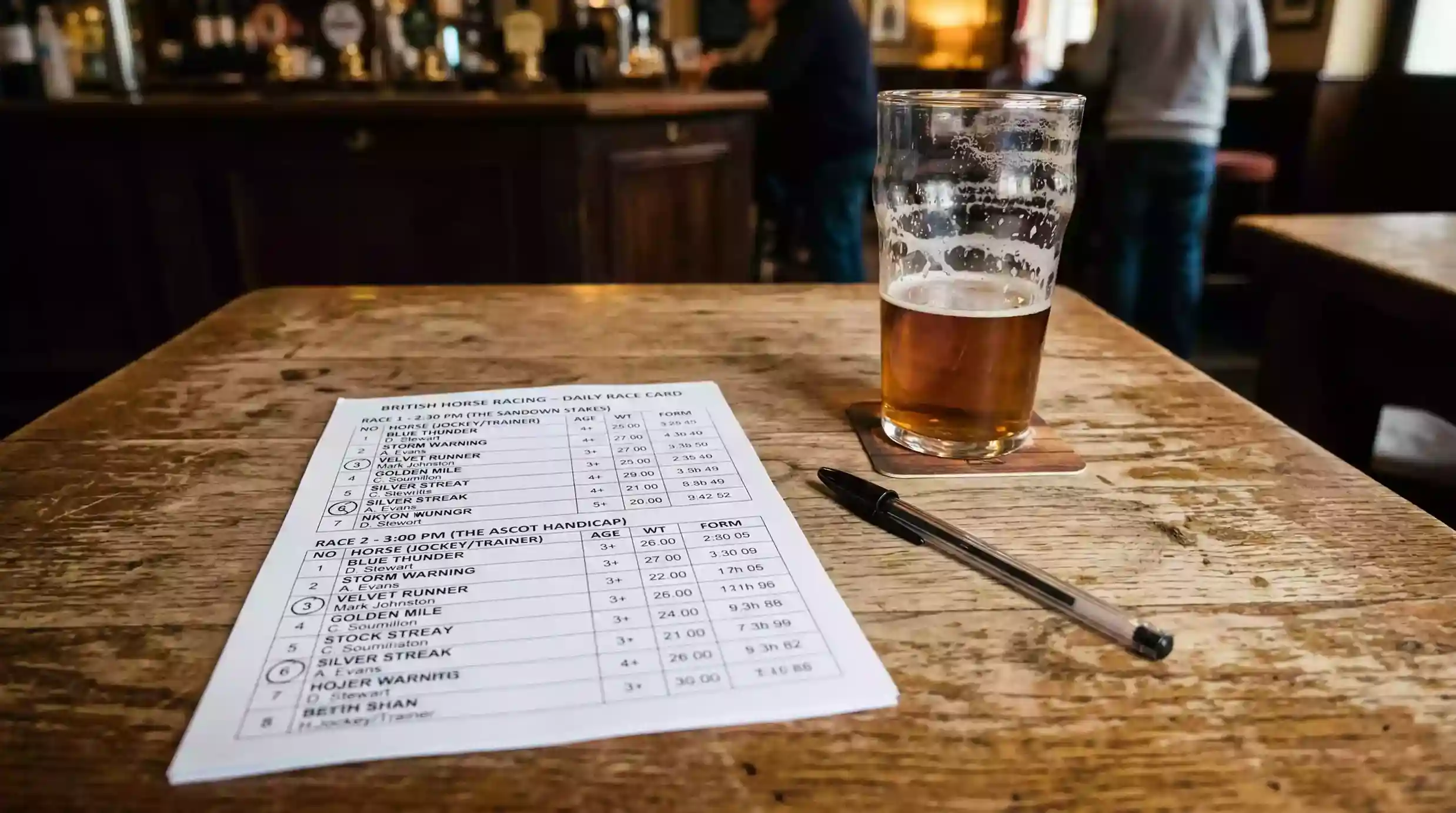
Start with the field size. Count the declared runners and immediately calculate the full wheel cost for the bet type you are considering. If the full wheel cost exceeds your per-race budget before you have looked at a single runner, you already know you need to part-wheel or look at a different bet type. This five-second check prevents you from falling in love with a key horse and then discovering the ticket price is three times what you can afford.
Next, identify your key horse. This is the horse about which you have the strongest positional opinion. Not the horse you think is most likely to win – the horse you are most confident about placing in a specific position. Sometimes that is the likely winner. Sometimes it is a horse you strongly believe will finish second. The key selection should be your clearest, most defensible view of the race.
Then, decide the key position. Are you playing a top wheel (key to win) or a back wheel (key to a lower position)? If your key horse is a front-runner with a clear tactical advantage, key to win. If it is a consistent placer, consider keying for second or third. The position choice should follow logically from the horse’s racing style and form profile.
Now assess the open positions. Look at every remaining runner and ask one question: does this horse have a realistic chance of finishing in the relevant positions? Be honest. If a horse has not finished in the first three in its last six starts, is stepping up two furlongs in trip and is drawn widest of all, the answer is probably no. Remove it from the pool. Every runner you exclude saves you combinations.
Calculate the final cost. With your key horse, key position and selected runners identified, run the formula. If the total fits your budget, place the bet. If it does not, either trim more runners from the open positions or reduce your unit stake. Never adjust by adding more key horses unless you genuinely hold strong opinions about multiple positions – adding a key just to reduce cost is a false economy if the key horse lets you down.
The entire process takes two to three minutes per race once you have practised it. For a six-race afternoon card, that is fifteen to twenty minutes of structured planning that prevents the kind of impulsive, under-costed wheel bets that drain bankrolls.
Frequently Asked Questions
What is a back wheel in horse racing?
A back wheel keys your selected horse into a lower finishing position – second in an exacta, or second or third in a trifecta – and wheels the remaining runners through the higher positions. Unlike a standard top wheel where your key horse is fixed in first place, a back wheel bets on your key horse finishing behind other runners. The cost is identical to a top wheel with the same number of combinations. Back wheels suit horses with consistent placing form who reliably finish in the frame without winning.
Can I combine a full wheel in one leg with a part wheel in another?
Yes, and this is one of the more sophisticated wheel structures available. In a trifecta, you can key a horse to win, use a full wheel for second place (every remaining runner) and a part wheel for third place (a selected group). The combination count is (n – 1) x s, where s is the number of selected runners for third. This gives you complete second-place coverage while narrowing the third-place options to save cost. The approach is useful when you are confident about the winner, agnostic about the runner-up, but believe third place will come from a smaller subset of the field.
How many runners should a race have before a full wheel becomes impractical?
For trifecta wheels with one key horse, the practical ceiling is roughly 12 runners, which produces 110 combinations at 1 pound per unit. Beyond 12, full wheel costs escalate quickly – 14 runners produce 156 combinations, 16 produce 210, and 20 produce 342. Most bettors with standard session budgets find part-wheeling necessary above 12 runners. For exacta wheels, the linear cost scaling (n – 1 combinations) keeps full wheels affordable even in 20-runner fields at 19 combinations. For superfecta wheels, full coverage is impractical above 8 or 9 runners due to the cubic cost growth.
Created by the ”Horse Racing Wheel bet Calculator” editorial team.