Trifecta Wheel Cost: Ready-Reckoner Tables From 6 to 20 Runners
 Available in US
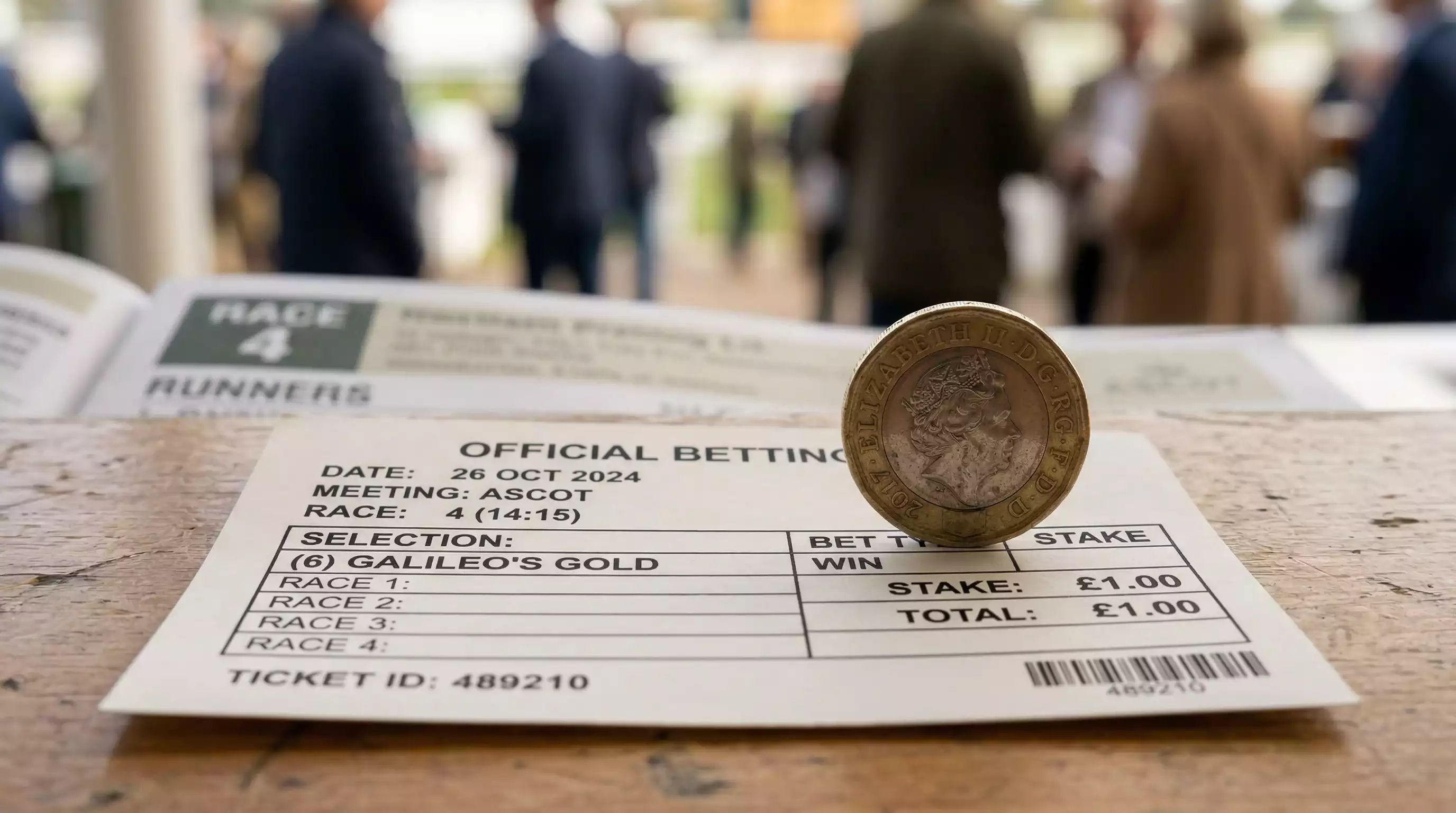
I once watched a punter at Newmarket queue up for a full trifecta wheel on a 16-runner handicap, convinced it would cost him around forty quid. The Tote terminal spat out a ticket north of two hundred pounds. His face told the whole story. That moment captures exactly why you need a ready-reckoner before you commit – the maths behind trifecta wheels is not intuitive, and the numbers escalate fast once field sizes push past double figures.
A trifecta wheel – or tricast wheel in UK parlance – locks one horse into a fixed finishing position and lets the remaining runners fill the other two places. The total number of combinations, and therefore the total cost, hinges on how many runners line up and how many positions you leave open. With the average Flat field in 2025 sitting at 8.90 runners, a typical full wheel is manageable. But Premier fixtures averaged 11.02 runners across the same season, and that jump from 9 to 11 nearly doubles your ticket price. The tables below strip the guesswork out entirely.
Every cost figure in these tables uses the simplest formula: combinations multiplied by unit stake. No deductions, no dividends – just what you hand over at the window or type into the app. I have split the tables into one-key and two-key structures so you can match the right table to the wheel you actually plan to build.
Full Trifecta Wheel Costs With One Key Horse
A full trifecta wheel with one key horse fixes that selection in first place and wheels every other runner through second and third. The combination count follows a clean formula: (n-1) x (n-2), where n is the total number of runners. You then multiply by your unit stake to get the ticket price.
Here is what that looks like in practice at a 1-pound unit stake (double these figures for a 2-pound unit). A 6-runner race produces 20 combinations for 20 pounds. At 7 runners that rises to 30, at 8 runners to 42, at 9 to 56, and at 10 to 72 pounds. Moving into double-digit fields, 11 runners cost 90, 12 runners cost 110, 13 runners 132, and 14 runners 156. The upper end is where budgets start to strain: 15 runners produce 182 combinations, 16 runners 210, 17 runners 240, 18 runners 272, 19 runners 306, and a full 20-runner field generates 342 combinations at 342 pounds per unit.
The acceleration is relentless. From 8 to 12 runners the cost roughly triples. From 12 to 16 it nearly doubles again. At 20 runners you are looking at 342 combinations on a single key horse – that is 342 pounds at a one-pound unit, which is a serious afternoon spend for most punters.
I tend to think of the 8-to-12 band as the sweet spot. The ticket stays under 110 pounds at a pound a unit, the fields are competitive enough for decent dividends, and you still have genuine coverage. Once you push past 14 runners, the cost-to-coverage ratio starts working against you unless you have very strong conviction in your key selection.
One detail worth flagging: these figures assume every declared runner goes to post. Late withdrawals reduce n and therefore reduce your cost, but they also reduce your coverage. If your key horse is scratched, the entire wheel collapses and you receive a refund. For a deeper look at trifecta wheel pricing with formulas and worked examples, the full calculator guide breaks the mechanics down step by step.
Part Trifecta Wheel Costs With Two Key Horses
Last summer I helped a friend structure a part wheel at Goodwood. She had two horses she was confident about – one for first, one for second – and wanted to wheel the field through third. Her ticket dropped from 90 pounds to just 9. That is the power of adding a second key: you are no longer multiplying two open legs together, you are filling just one.
With two key horses fixed in first and second, the formula simplifies to (n-2), because only third place rotates through the remaining field. At a 1-pound unit, a 6-runner race costs just 4 pounds, 8 runners cost 6, 10 runners cost 8, 12 runners cost 10, 14 runners cost 12, 16 runners cost 14, and even a 20-runner field costs only 18 pounds. At a 2-pound unit, simply double each figure.
The difference is dramatic. A 12-runner race that costs 110 pounds as a one-key full wheel drops to just 10 pounds with two keys locked in. You are paying one-eleventh of the price. The trade-off is obvious: both key horses must finish exactly where you placed them, or the bet is dead.
There is a middle option too – fixing one horse in first and selecting a subset of runners for second, then wheeling the rest through third. That creates a custom part wheel where the cost sits somewhere between these two tables. I find it useful when I have a strong view on the winner but only moderate confidence on the runner-up. You pick three or four contenders for second and let the field fill third. On a 10-runner race with one key and four selections for second, the cost is 4 x 5 = 20 combinations – a fraction of the 72-combination full wheel but with much better coverage than the two-key structure.
How Unit Stake Scales Your Total Ticket Price
A question I get asked more than any other at the track: does the Tote let you bet below a pound per combination? The answer matters because it cuts your ticket price proportionally. The UK Tote minimum unit for exotic pools is currently 1 pound on most platforms, though some digital partners allow 50p units on certain pool types. At 50p the entire table halves – a 12-runner one-key wheel drops from 110 to 55 pounds, which suddenly makes large-field racing far more accessible.
The scaling is perfectly linear. Whatever your unit stake, multiply it by the combination count from the figures above and you have your ticket price. There are no volume discounts, no sliding scales – the maths stays clean. A 2-pound unit doubles the cost. A 5-pound unit on a 10-runner one-key wheel puts you at 360 pounds. I have seen punters do it, usually at festival meetings where pool sizes justify the outlay, but for regular Saturday afternoon racing a 1-pound or 50p unit keeps the budget sensible.
One thing to watch: the unit stake affects your return proportionally too. A 50p unit pays half the declared dividend per unit. So while the barrier to entry drops, the potential return drops with it. There is no free lunch in pool betting – you are simply scaling your exposure up or down.
When the Numbers Steer You Away From a Full Wheel
These tables are not just reference material – they are a decision tool. If you look up the cost and it exceeds what you have budgeted for a single race, that is the table telling you to restructure. Add a second key horse. Drop to a part wheel with selective second-place runners. Or skip the trifecta entirely and consider an exacta wheel, where the combination counts are materially lower because you are only filling two positions instead of three.
The numbers do not lie, and they do not negotiate. Print these tables, bookmark this page, or screenshot them onto your phone before your next raceday. Five seconds of checking beats that moment of shock at the Tote window every single time.
What is the cheapest trifecta wheel possible in a UK race?
The cheapest trifecta wheel is a two-key part wheel in a six-runner race at minimum unit stake. With both first and second fixed, you have just four combinations. At 1 pound per unit that is a 4-pound ticket. At 50p per unit, where available, the cost drops to 2 pounds.
How does a 50p minimum unit affect trifecta wheel cost?
A 50p unit halves every figure in the cost tables. A 10-runner one-key full wheel drops from 72 pounds to 36 pounds. The trade-off is that your declared dividend payout is also halved, since returns are calculated per unit stake. The structure and combination count remain identical – only the monetary scale changes.
Written by the editors at Horse Racing Wheel bet Calculator.