UK Tote Trifecta Dividend: What Drives Tricast Payouts and How to Read Them
 Available in US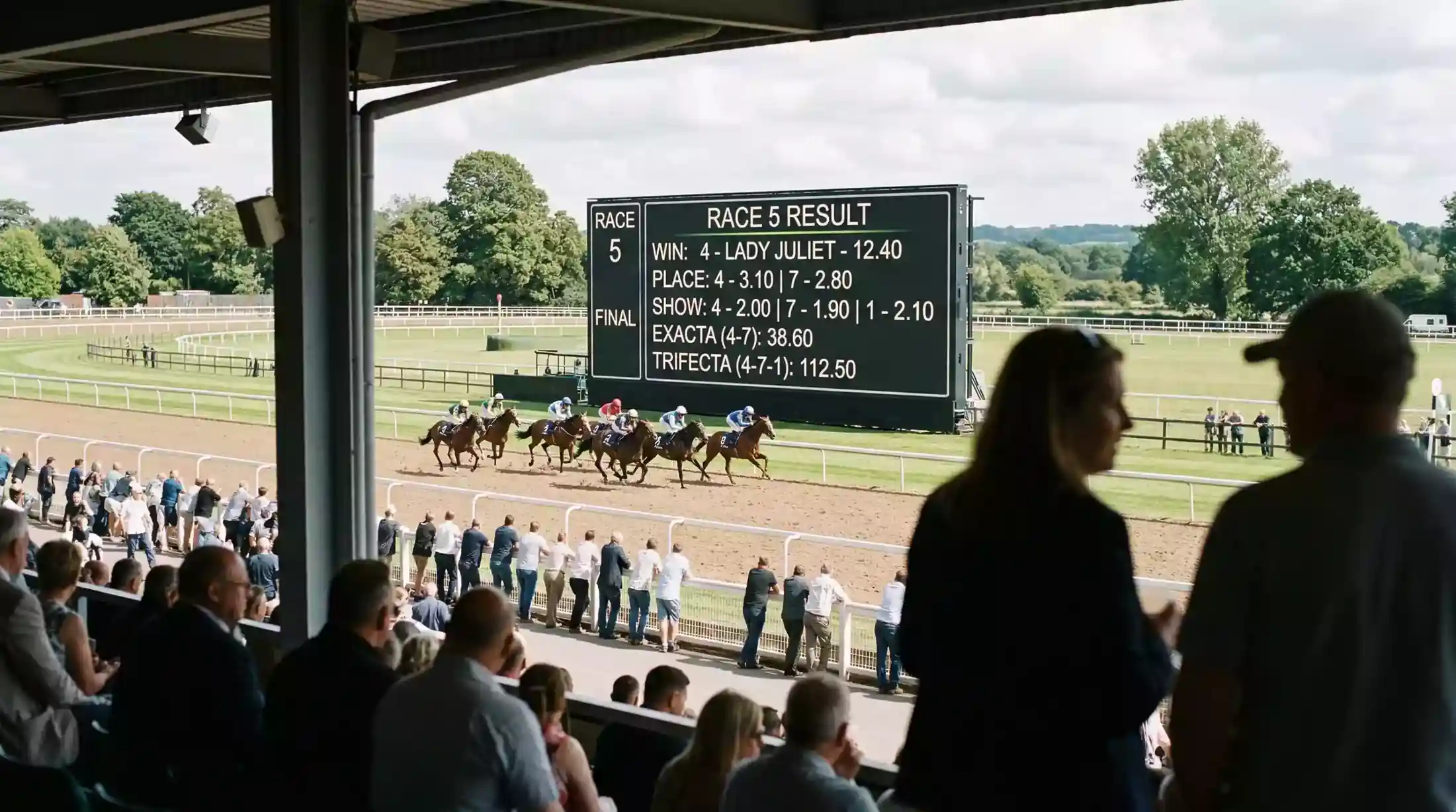
The largest single Tote payout I can find on record is Steve Whiteley’s 1.45 million pounds from a 2-pound Jackpot bet at Exeter in 2011. That figure captures the imagination, but it also obscures a more useful truth: most Tote Trifecta dividends are far more modest, and understanding what pushes them up or pulls them down is worth more to a regular wheel bettor than chasing the next life-changing ticket. The tricast pool is a shared pot, and the size of your slice depends on factors that are predictable once you know what to look for.
How the Tote Distributes the Tricast Pool
The Tote takes a 25% deduction from the Trifecta pool before any dividend is calculated. That percentage is consistent across all exotic pools – Exacta, Trifecta, Superfecta – and covers the operator’s commission plus mandatory contributions to the Horserace Betting Levy. The deduction range across all Tote pools runs from 16% on Win bets to 28% on the Jackpot, with exotics sitting squarely at the 25% mark.
After the deduction, the remaining 75% of the pool is the net pool. This is divided by the total number of winning units – every 1-pound unit staked on the correct first-second-third combination. The result is the declared dividend per unit. If the net pool is 15,000 pounds and 10 units backed the winning combination, the dividend is 1,500 per unit. If 100 units backed the same combination, the dividend is 150 per unit.
The critical insight is that you are not betting against the Tote. You are betting against every other punter in the pool. The Tote takes its cut before the game begins. Everything after that is a distribution problem among the winners. Your dividend is determined by two things: how much money is in the pool, and how many other people backed the same result.
Four Factors That Push Trifecta Dividends Up or Down
Over nine years of tracking Tote results I have isolated four factors that account for most of the variance in tricast dividends. They interact in ways that are not always obvious, and understanding the interaction matters more than knowing any single factor in isolation.
Pool size is the foundation. Larger pools produce more stable dividends because the money is distributed across more combinations. Premier meetings like Royal Ascot and the Cheltenham Festival generate deep pools, and dividends there tend to reflect the actual difficulty of the result. On a Tuesday evening at Southwell, the pool might be a few thousand pounds, and the dividend becomes disproportionately sensitive to how the money fell across the combinations.
Result predictability is the swing factor. When the first three home were all well-fancied, more punters hold winning units, and the dividend compresses. When a 50/1 outsider finishes third or a 20/1 shot wins, far fewer punters have the combination, and the dividend balloons. The average Flat field in 2025 was 8.90 runners, which produces 504 possible finishing orders for the first three places in a full field. Most of those orderings attract zero or negligible stakes. The dividend reward goes overwhelmingly to results the crowd did not anticipate.
Field size amplifies both cost and dividend potential. A 6-runner race has just 120 possible tricast permutations. A 16-runner race has 3,360. Larger fields spread the pool across more possible outcomes, which means any single outcome is less likely to be heavily backed. This generally pushes dividends higher in big fields, though the relationship is not linear – it depends on how the market concentrates money on a few likely outcomes versus spreading it widely.
Favourite position in the result acts as a dial. If the favourite wins, more punters have the first leg correct, which increases the number of winning units and lowers the dividend. If the favourite finishes second or third, fewer punters have it in the right position, and the dividend improves. If the favourite finishes outside the first three entirely, the pool pays out only to those who bypassed the market leader, and dividends can be exceptional.
Reading Declared Dividends: Per-Unit Payout Explained
Declared Tote dividends are always quoted per 1-pound unit. If the declared Trifecta dividend is 340.20, that means every 1-pound unit on the winning combination returns 340.20 pounds. If you staked 2 pounds per unit, your return is 680.40. If your wheel contained 72 combinations at 1 pound each and one of them was the winning combination, your gross return is 340.20 from a 72-pound outlay – a net profit of 268.20.
That net calculation is where wheel bettors need to be honest with themselves. A 340-pound dividend sounds impressive until you subtract the 72-pound ticket cost. And if the dividend had been 60 pounds instead – which is perfectly possible in a race where the result was relatively predictable – your net return would be negative: 60 – 72 = a 12-pound loss despite holding the winning combination. This happens more often than casual exotic bettors expect. Winning the tricast does not guarantee profit if your ticket cost exceeded the dividend.
I always compare the potential dividend range to my ticket cost before placing a wheel bet. If the field is small, the pool is thin, and the likely result involves well-backed horses, the expected dividend may not cover a full wheel. In those situations, a part wheel or a straight tricast targeting a specific outsider combination offers a better risk-return profile.
The declared dividend is also net of the 25% Tote deduction. There is no further commission to pay. What you see published is what you receive per unit. Tax is not deducted at source from UK pool betting winnings, though you are responsible for your own tax obligations. The simplicity of the payout – one number, per unit, net of deductions – is one of the things that makes Tote betting mechanically cleaner than navigating bookmaker terms with Rule 4 adjustments, dead heat reductions, and each-way place term variations.
For a full breakdown of how the 25% deduction and other Tote pool deduction rates shape dividends across every pool type, the deductions guide covers Win through Superfecta in detail.
What are typical UK Tote Trifecta dividends?
Dividends vary enormously depending on pool size, field size and result predictability. On a midweek 8-runner race with a short-priced favourite winning, the tricast dividend might be 30 to 80 pounds to a 1-pound unit. On a competitive 14-runner handicap at a Premier fixture with a surprise result, dividends routinely exceed 500 pounds and can reach into the thousands. There is no typical figure – the range reflects the diversity of UK racing conditions.
Does the Tote Guarantee apply to Trifecta pools?
The Tote Guarantee – which ensures Tote Win and Place returns match or exceed the Industry Starting Price – does not extend to exotic pools including the Trifecta. Exotic dividends are determined entirely by the pool distribution after the 25% deduction. There is no floor price on Trifecta payouts, which is why pool size and combination popularity have such a direct impact on what you receive.
Prepared by the Horse Racing Wheel bet Calculator editorial staff.