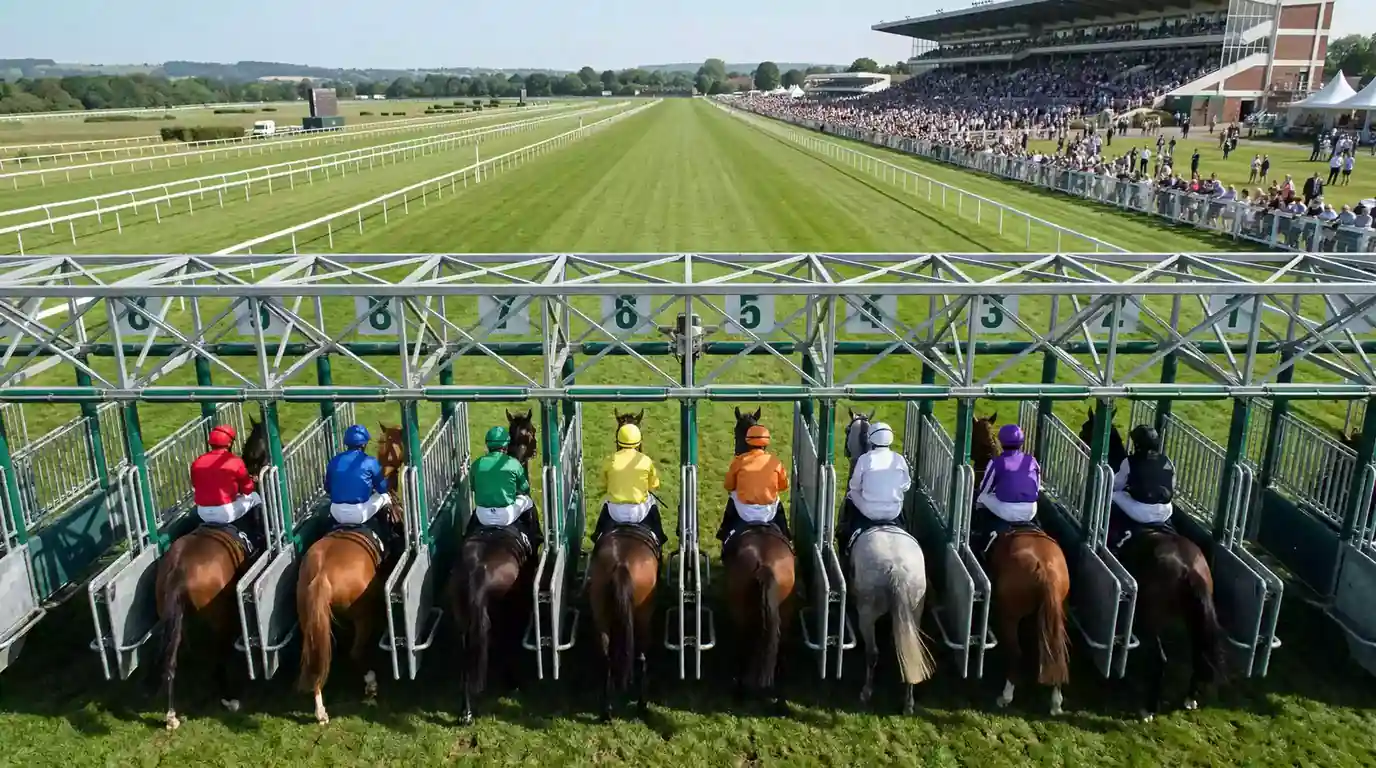
Wheel Bet Formula for Horse Racing: The Permutation Maths Behind Every Ticket
 Available in US
I once overheard a punter at Newbury describe his trifecta wheel as “just a few combos”. His ticket cost 156 pounds. The gap between intuition and arithmetic is where most exotic bettors lose money before the race even starts. Every wheel bet is built on a permutation formula – a precise mathematical relationship between the number of runners, the number of keyed positions and the total combinations on your ticket. Know the formula and you know the cost. Guess at it and you are the punter at Newbury.
Permutations vs Combinations: Why Wheel Bets Use Order
A combination is a selection where order does not matter. Pick three horses from a field – the group is the same regardless of which one you name first. A permutation is a selection where order matters. First, second and third are distinct finishing positions, and horse A finishing first with B second is a different outcome from B finishing first with A second.
Wheel bets deal in permutations because the exotic bets they represent – forecasts, tricasts, superfectas – all require horses to finish in specific positions. The distinction matters enormously for cost. The number of combinations for choosing 3 horses from 10 is 120. The number of permutations for ordering 3 horses from 10 is 720. Same field, same three positions, six times the count. That multiplier is exactly what makes exotic bets expensive and exactly why wheel structures exist to control the cost.
The formula for permutations without repetition is P(n,r) = n! / (n-r)!, where n is the total number of items and r is the number of positions. For wheel bets with key horses, the formula simplifies because keyed positions are fixed and only the open positions contribute to the permutation count.
Formula Reference: Exacta, Trifecta, Superfecta and Quinella Wheels
Here is every formula I use, laid out with the variables defined once. n = total runners in the race. k = number of key horses fixed in specified positions. s = number of selected runners in a part wheel’s open leg (if restricting from full field). Unit stake is always multiplied at the end to convert combinations into cost.
The UK Tote applies a 25% deduction to exotic pools – Exacta, Trifecta and Superfecta. That deduction affects your dividend, not your ticket cost. The formulas below calculate combinations and cost only.
Exacta (Forecast) – one key, full wheel: Combinations = (n – 1). You key one horse in first (or second, for a back wheel) and every other runner fills the remaining position. On a 10-runner race: 9 combinations.
Exacta – one key, part wheel: Combinations = s, where s is the number of runners you select for the open position. On a 10-runner race with 4 selections for second: 4 combinations.
Trifecta (Tricast) – one key, full wheel: Combinations = (n – 1) x (n – 2). Two open positions each reduce by one available runner. On a 10-runner race: 9 x 8 = 72 combinations.
Trifecta – two keys, full wheel: Combinations = (n – 2). One open position filled by all remaining runners. On a 10-runner race: 8 combinations.
Trifecta – one key, part wheel with s selections for second: Combinations = s x (n – 2) or s x (s2 – 1) if both non-key legs are restricted. The exact formula depends on whether you restrict one open leg or both.
Superfecta – one key, full wheel: Combinations = (n – 1) x (n – 2) x (n – 3). Three open positions. On a 10-runner race: 9 x 8 x 7 = 504 combinations. On a 14-runner race: 13 x 12 x 11 = 1,716. The cost explosion is severe.
Quinella (Swinger) – no key, full wheel: The quinella is order-independent. Combinations = n x (n – 1) / 2. On a 10-runner race: 45 combinations. This is half the exacta permutation count because each pair appears once rather than twice.
Plugging Real Field Sizes Into the Formulas
Theory is useful. Worked examples are better. The average Flat field in 2025 was 8.90 runners u2013 call it 9 for clean maths. Premier Flat fixtures averaged 11.02 u2013 call it 11. At a 1-pound unit with one key horse, an exacta full wheel costs 8 pounds on a 9-runner field, 10 on an 11-runner field, and 13 on a 14-runner field. A trifecta full wheel costs 56, 90, and 156 respectively. A superfecta full wheel costs 336, 720, and 1,716.
The exacta scales gently. The trifecta accelerates. The superfecta detonates. Going from 9 to 14 runners, the exacta cost increases by 63%. The trifecta cost increases by 179%. The superfecta cost increases by 411%. That divergence is why I rarely play full superfecta wheels except on small Jump fields where the runner count stays in single digits.
Part wheels change the economics entirely. If I key one horse in first and restrict the second-place leg to 4 selections on a 14-runner trifecta, the formula becomes 4 x 12 = 48 combinations – less than a third of the full wheel’s 156. Adding a second key brings it down further: 4 combinations for second, all runners for third = 4 x 12 = 48, or if I key first and second with the field in third: 12 combinations. The formula is the lever; the key horses are the fulcrum.
One mistake I see regularly is punters applying the wrong formula type. A combination forecast and a full exacta wheel are not the same structure. The combination forecast covers every permutation of a selected group – n x (n-1) across all selected runners. The full exacta wheel keys one horse and covers (n-1) runners in the open position. On a 10-runner race with 4 selected horses, the combination forecast costs 12 permutations. A one-key exacta wheel on the same race costs 9. The structures answer different questions: “which pair from my group finishes first and second?” versus “what finishes second behind my key horse?”. Applying the wrong formula means either overpaying for coverage you did not intend or missing combinations you thought you had.
Every formula on this page does the same job: it converts your opinion about a race into a precise ticket cost. The opinion is the qualitative part – which horse wins, which ones place, how many runners you can eliminate. The formula is the quantitative part – how much that opinion costs to express as a bet. Master both and you have the complete toolkit for exotic wagering. For step-by-step application of these formulas with tables and worked costs, the main wheel bet calculator guide covers every scenario in detail.
Why do wheel bets use permutations instead of combinations?
Because finishing order matters. A forecast requires horse A to finish first and horse B second – A-B is a different outcome from B-A. Permutations count each ordering separately, which is why exotic bets have more possible outcomes and higher costs than combination-based bets like each-way multiples.
Does the formula change for a part wheel with multiple key horses?
Yes. Each additional key horse removes one open position from the formula. A one-key trifecta wheel has two open legs: (n-1) x (n-2). A two-key wheel has one open leg: (n-2). A three-key wheel is a straight tricast with one combination. The more positions you fix, the fewer permutations remain and the lower the cost.
Created by the ”Horse Racing Wheel bet Calculator” editorial team.