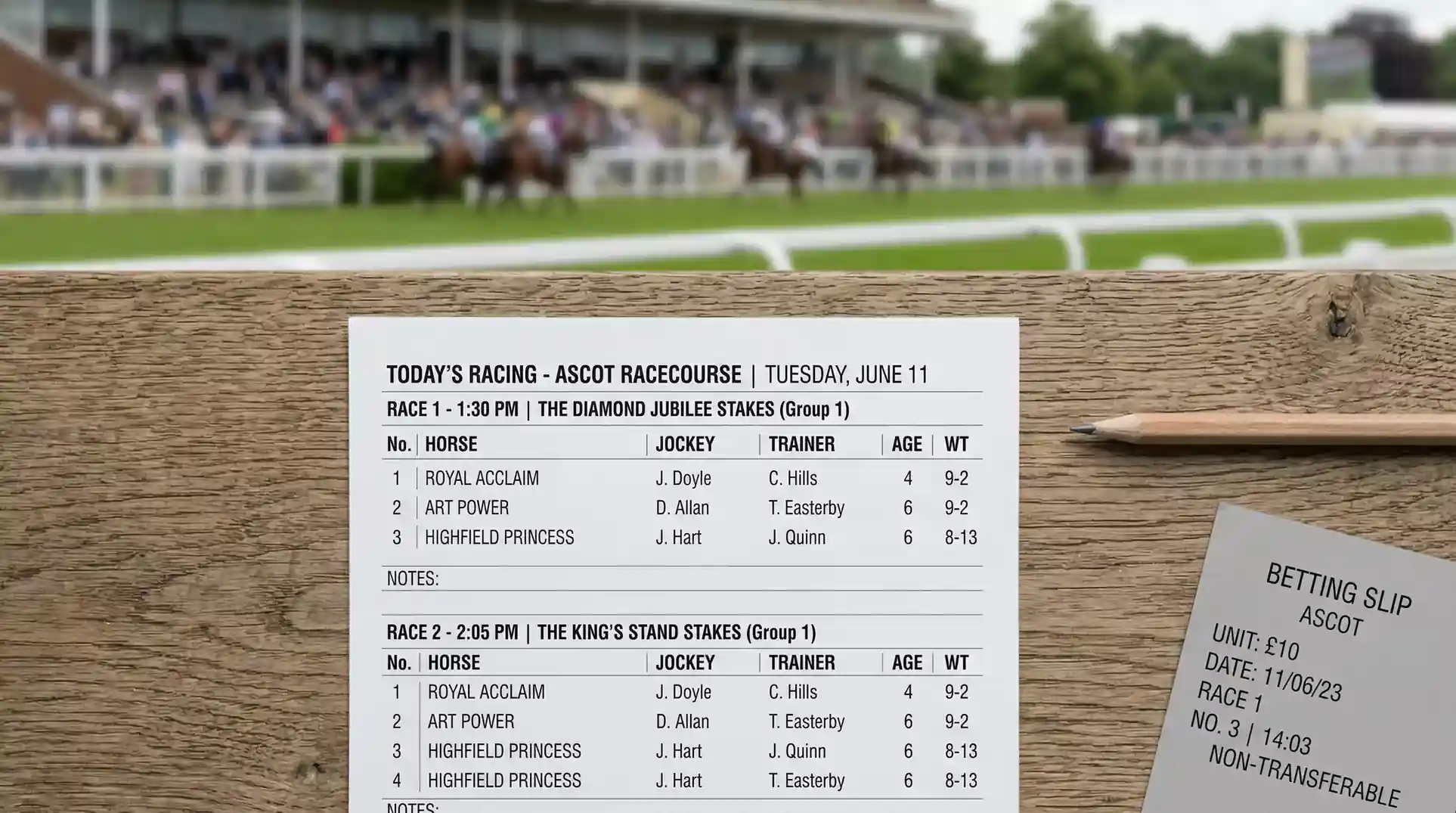
Key Horse Wheel Bet: Anchoring Exotic Combinations to Control Cost
 Available in US
Every wheel bet starts with a decision: which horse do you trust enough to lock into a fixed finishing position? That horse is your key – the anchor around which every other combination revolves. Get the key right and the wheel gives you broad coverage at a controlled price. Get it wrong and the entire ticket is wasted regardless of what the other runners do. In nine years of building exotic bets, I have come to see key horse selection as the single most consequential step in the process – more important than field size, more important than unit stake, more important than which bet type you choose.
Single Key Horse: Fixing One Position in the Wheel
At Doncaster last season I watched a mare I had been following all summer line up as a 5/4 favourite in a 10-runner fillies’ handicap. My form analysis gave her a 55% chance of winning – well above the market implied probability. She became my key horse, locked into first place, with every other runner filling second and third in a trifecta wheel. The ticket cost 72 pounds. She won by a length and a half, the tricast paid 84 pounds to a one-pound unit, and the total return covered almost every losing wheel I had played that month.
A single key horse in first place is the most common wheel structure. With the average Flat field sitting at 8.90 runners in 2025, a one-key trifecta wheel costs (n-1) x (n-2) combinations – roughly 56 on a 9-runner race, 72 on a 10-runner, 110 on a 12-runner. The key horse absorbs the uncertainty of one entire finishing position, which is what makes wheel costs manageable in medium-sized fields.
The key does not have to go in first. You can key a horse in second or third – a structure known as a back wheel. I use bottom-position keys when I rate a horse strongly but suspect it lacks the turn of foot to win outright. A talented but one-paced stayer keyed in third, for example, lets you explore combinations of faster horses for first and second while relying on your key to grind out a place.
Multi-Key Wheels: Two or Three Anchors for Greater Control
When I have opinions on more than one horse, the temptation to add a second key is strong – and the cost reduction is immediate. Premier Flat fixtures in 2025 averaged 11.02 runners, which means a one-key trifecta wheel costs 90 combinations at a pound. Add a second key – locking two horses into first and second – and the cost drops to (n-2), which is 9 combinations. A 90% reduction in ticket price from one additional conviction.
Three keys take it further. Fixing horses in first, second and third is essentially a straight tricast – one combination, one pound. There is no wheel element at all. The three-key structure only makes sense if you have extreme confidence in the exact finishing order. I use it once or twice a season, usually in small-field Group 1 races where the formbook leaves little ambiguity.
The two-key wheel is the structure I use most often. It occupies the practical middle ground between the broad coverage of a single key and the precision of a straight tricast. At a 1-pound unit, an 8-runner race produces just 6 combinations, 10 runners cost 8 pounds, 12 runners cost 10, 14 runners cost 12, and even a 16-runner field costs only 14 pounds.
Even in a 16-runner handicap, a two-key trifecta wheel costs just 14 pounds at a one-pound unit. Compare that to the single-key cost of 210 pounds on the same field. The trade-off is obvious: you are betting that both your keyed horses finish exactly where you placed them. If one of them runs second instead of first, the bet fails.
How to Identify a Reliable Key Horse on the Race Card
Richard Wayman, the BHA’s Director of Racing, has spoken about making British racing’s best competitions better and using quality as the tool to grow interest in the sport. That same principle applies to your key horse selection – you want to key quality, not just price. A short-priced favourite is not automatically a good key. An underrated improver at 7/2 might be a better one.
I look for three things in a potential key horse. First, consistency: a horse that finishes in the frame at least 60% of the time at today’s level. Second, conditions fit: going, distance, track configuration and class all aligning. Third, lack of vulnerability at the business end of the race – a strong finishing kick, a front-running style that controls the tempo, or a proven record of handling pressure in the final furlong.
What I avoid is keying a horse purely on odds. A 1/3 shot in a five-runner novice chase might look like a certainty, but the field is so small that a one-key trifecta wheel only costs 12 combinations and pays a modest dividend. Meanwhile a 5/2 shot in a 12-runner handicap, if your form study supports the selection, gives you a 110-combination wheel with much larger potential dividends. The key is not who the market says will win – it is who your analysis says will finish in the position you are keying, with enough margin for the cost to be justified.
Cost Reduction: Key Horse vs Non-Keyed Combinations
The entire economic argument for wheel bets rests on the key horse. Without a key, you are looking at combination tricasts and combination forecasts where every selected horse can appear in every position. With a key, you collapse one axis of variation entirely, and the cost drops proportionally.
On a 10-runner race, a combination tricast with four selected horses costs 24 permutations. A trifecta wheel keying one of those four in first and wheeling the other three through second and third costs 3 x 2 = 6 permutations. The key horse reduced the ticket by 75%. On the same race, a one-key trifecta wheel using all remaining runners costs 72 combinations – much more than the four-horse combo tricast, but covering far more outcomes. The key gives you a lever: you can adjust how many runners fill the open positions, dialling cost up or down without changing the fundamental structure.
This flexibility is why I structure almost every exotic bet as a wheel rather than a combination. The key horse is the constant; everything else is variable. If my budget for a race is 30 pounds, I work backwards from there: at a one-pound unit, I need a structure with no more than 30 combinations. A one-key exacta wheel on a 10-runner race gives me 9 combinations for 9 pounds – room to spare. A one-key trifecta wheel on the same race gives me 72 combinations – too many. So I add a second key or restrict the non-key legs to a subset of runners. The full wheel vs part wheel comparison breaks down exactly when each structure makes sense relative to your budget and conviction level.
The key horse, ultimately, is your edge made structural. It is the single point of maximum confidence translated into bet architecture. Everything else on the ticket is coverage – necessary, useful, but secondary. Build your wheels outward from the key, not inward from the field.
Can the same horse be keyed in multiple legs of a trifecta wheel?
No. Each horse can only appear once in any single permutation. If you key a horse in first place, that horse cannot also appear in second or third within the same trifecta. The key fixes one horse in one position, and the remaining positions are filled exclusively by other runners.
What happens to my key horse wheel bet if the key horse is a non-runner?
If your key horse is withdrawn before the race, the entire wheel collapses because every combination on the ticket included that horse. You receive a full refund on the bet. If a non-key horse is withdrawn, your ticket is recalculated with the reduced field – the combinations involving the withdrawn runner are removed and the corresponding stake is refunded.
Written by the editors at Horse Racing Wheel bet Calculator.